WW-Speakers
Tympanum
“Woodworks and wood works!”
by Keijo Tanskanen
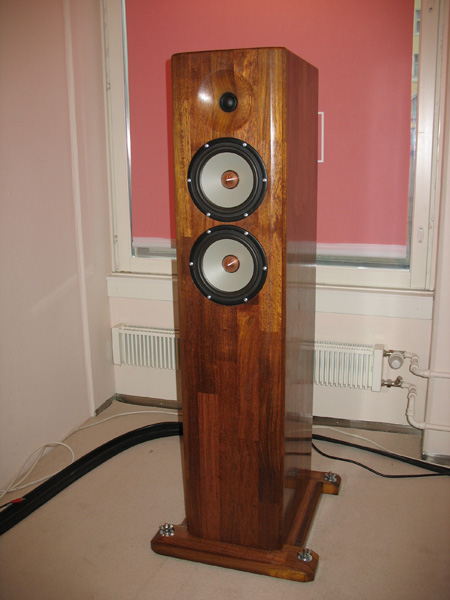
WW-Speakers
Tympanum
“Woodworks and wood works!”
by Keijo Tanskanen
Isn’t this beautiful!
Foreword
For some reason there are many high quality speaker manufacturers in Finland. A list of them is a long one: Amphion, Aurelia, Avalanche, Forvoice, Genelec, Gradient, Harrin kaiutin, OR, Penaudio, Profel, Trinec and so on. Now, a brand new vendor, WW-Speakers, has come along and the list becomes even longer.
It took approximately two years for WW-Speakers to develop their first model, W1 Tympanum. During this time period, they went through numerous trials and errors to improve the speaker’s features. Especially, finding the right element selection and a good construction for the enclosure took plenty of working hours. There were times when the search drove the developers to despair, but in the end, the hard work produced results and acceptable solutions were found.
I was contacted to come
and have a look at W1 Tympanum at Musiikin.com. Naturally, I accepted the proposal.
I made a plan to spend only two hours on the listening session because my objective
was not to make an extensive article, but merely a short review about my first
impressions on the speaker and to shed light on the technical features. The
plan worked well and the visit was rewarding!
Design
W1 Tympanum is a 3.5 way speaker. It has a 9-inch Scan Speak woofer, which is driven by a 500 W class D amplifier (1000 W is an option). The midrange units are slightly modified with 6.5-inch Seas Excel cones and highs are cared by a soft-dome tweeter including a director. Each element is housed in its own space, and each midrange cone has even differently sized housing. The binding-post options are from WBT and Mundorf.
Tympanum has a hard-wired crossover. The crossover frequencies are 50-60 Hz, 330 Hz and 1800 Hz. A third order low pass filter is used for feeding the woofer. The upper crossover frequencies have first order high and low pass filters. All the components of the crossover have been carefully selected. For example, foil cones and Mundorf capacitors can be found from the component selection.
The enclosure of the speaker has been made from a glue-laminated timber (merbau or walnut), the thickness of which is 4 cm. In addition, every element has been separated to its own housing by using the very same glue-laminated timber. When all the elements, cablings and the amplifier have been installed, the speaker’s weight comes near to 90 kg! The entire construction stands on four spikes. One can guess, of course, that as a consequence the speaker is not easy to handle. To finish the speaker, WW-Speakers has used hard wax and the result is very distinguished indeed.
For more detailed information: http://www.ww-speakers.com/w1_home.html
Listening session
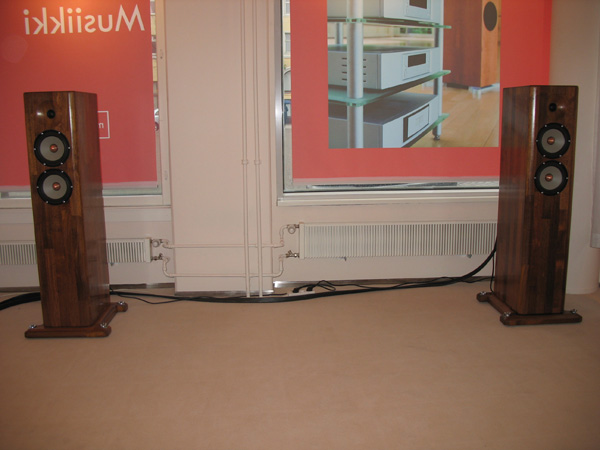
The system had Linn’s high quality front end and the speakers were directed straight ahead (zero in-toed). The front of the speakers was a bit less than a meter away from the side and back walls. After discussing with the personnel, I placed myself on the best seat in the house and the show was ready to begin.
I started my session sensitively and loaded the Burmester test CD III into the player. The first song was Paganini’s Sonata Concertata. Immediately, I heard that this speaker is able to deliver lot of spatial information. The sound was very airy and the reverberation of the church was very well produced, although the preciseness in focussing was somewhat generous. The violin and guitar sounds were steady and coherent with slight extra softness. Then, I listened to some organ music. I was totally surprised by the bass extremes as even the lowest tones could be heard well! This is an achievement from a speaker that has a single 9-inch woofer! After this positive experience, I did notice, however, that there was a slight absence of the bass energy in the upper part of the low register. But in all honesty the absence was so small that talking about it feels like splitting hairs. Once again, the space of the church was honourably produced into the listening room.
Now, it was time to check the dynamics of the speaker. For that I used the Reference Records Respighi and George Duke’s After Hours CDs. Tympanum proved to deliver dynamics very well but certainly it isn’t a monster in this area. The same can be said about the control as well. However, after listening to the records, I became convinced that the upper frequency range worked very well indeed. The treble of Tympanum is clean, imperceptible but slightly soft. It matches very well to the overall nature of the speaker! Also, the critical midrange gave nice results. Nevertheless, a faint thought flashed in my mind that there might be a bit extra forwardness in some Diana Krall’s tsa or ssh vocal tones. Thus, I am not totally convinced about the cleanliness of the upper midrange.
My samples of live rock music produced expected results. The performances of Frank Marino and Pink Floyd were for the most parts as brutal as they should be. When audio enthusiasts listen to these kinds of recordings, slight softness may be even a virtue, at least according to some enthusiasts. Well, at least I liked the overall presentation of Tympanum. The sound seemed to have the very same nature through the entire audio frequency scale, although the over-all harmony seemed slightly to suffer from the midrange and upper bass behaviour. However, after the listening session, I noticed that I could have done another listen session in a row. For me this was a good sign because it meant that the positive features of the speaker were more prominent than the shortages and that the speaker was well suited for long term listening.
Summary
W1 Tympanum is an attractive speaker. I think that if speakers had a gender W1 Tympanum would be a purposeful female in a positive manner. It has an airy, slightly soft, and pleasant overall sound. And it does go low, VERY LOW. I have not met a floor-standee before, which would go this low in this size class. In the case of Tympanum, an extra subwoofer would be a waste of money.
Still, our “lady” couldn’t achieve the neutrality, preciseness and coherency that the best speakers in my listening experience have provided. However, the overall airiness of the Tympanum, including the reproduction of the spatial information, will bring plenty of delicious listening moments. This is not a matter of course even for more expensive speakers!
In my opinion this speaker is made for music listeners, not for music analysts. If you like to “pick up” details or transients from the music and want to have the highest class of neutrality, Tympanum may not be the right choice for you. For music analysts, WW-Speakers offers a quite different monitor model. But if your aim is just to enjoy music with great feeling, sipping a class of good wine (with your wife, perhaps?) aside, W1 Tympanum is a charming speaker that may give you a lifetime worth of pleasure. Cheers!
Used equipment